
A New Certification for Fossil Free Supply Chains
The Fossil Free Product Standard is a document published by the European Standards Committee CEN in April 2025 that allows companies to certify products with fully or partially fossil free supply chains. Any remaining fossil components have to be disclosed via a QR code on the product. The standard gives customers clarity on where businesses have ended fossil fuel use and paves the way for moving much more swiftly to a fossil free, renewable society.

Fossil Free Digital Products
The Fossil Free Product Standard also covers digital products, such as apps and websites. This allows developers of such products to have these products certified as fossil free, thereby contributing to a Fossil Free Internet.
A fossil free digital product certification tells users more than that the app or site runs on green hosting. Since the standard aims to certify the top levels of the digital supply chain, secondary-level services such as APIs, CDNs, and fonts must also be fossil free for the product to qualify as a 100% fossil free digital product.
Take Action
Flag a company that you think could certify its products.
Certify your products as fully or partially fossil free, demonstrating your company’s leadership.
Scope of the Fossil Free Product Standard
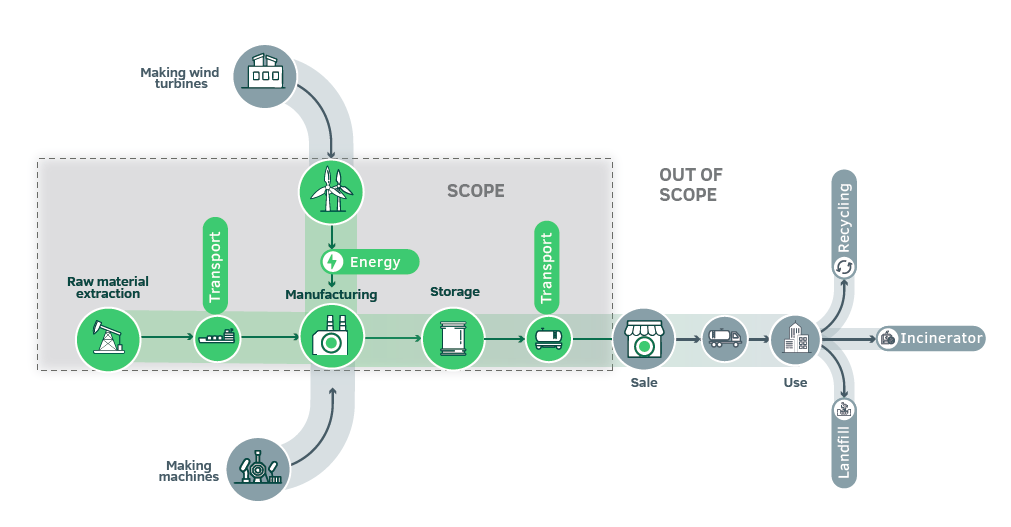
The Fossil Free Product Standard ensures that every production stage—from raw material extraction and processing to manufacturing, packaging and distribution—if free of fossil fuels and fossil materials. Third-party verification ensures accountability and delivers clear information accessible directly via a QR code on the product.
Learn more about the standard’s scope…
More information
- The full text of the standard
- Calculation method for partially fossil free products
- Consultation process (now complete)
Frequently Asked Questions
Why doesn’t the Fossil Free Product Standard require greenhouse gas emissions accounting?
The focus of the Fossil Free Product Standard is solely on eliminating fossil fuel use from supply chains. By removing fossil fuels, companies inherently reduce harmful greenhouse gas emissions. This direct approach avoids the complexity of traditional emissions calculations. Conincidentally, it makes certification of fossil free products much faster and cheaper than GHG accounting.
What if my supply chain cannot be entirely fossil fuel free right away?
The Standard recognises that eliminating fossil fuels immediately may not be feasible for every company. Products can be certified as “partially fossil free”, with the exact percentage of fossil free content clearly displayed and further details available via a QR code. This approach supports a gradual transition towards full decarbonisation.
Why are oil and fossil gas-derived materials not permitted in fully fossil free products—even if they are not used directly as fuels?
The extraction of oil and fossil gas is intrinsically harmful, as it causes environmental damage and leads among other things to methane gas leakage. Allowing these materials in fully fossil free products would perpetuate fossil fuel extraction projects, undermining the core objective. Products that include such materials can only be certified as partially fossil free.
How is a mixed supply chain with both fossil free and fossil-derived components handled?
The Fossil Free Product Standard requires a clear breakdown of the supply chain. The presence of any fossil-derived fraction will affect the overall certification level. This policy ensures transparency and encourages companies to minimise fossil fuel inputs throughout every stage of their supply chain.
Can a plastic product be considered fossil free?
Yes, if the plastic is produced from plant-based sources. If it is made from oil or fossil gas, it can only qualify as partially fossil free, with the non-fossil free elements clearly indicated.
Why are the energy choices of end-user devices excluded from the certification of digital products?
Certification focuses on the supply chain and operational control. End-user devices and their energy sources fall beyond the company’s direct control, so they are excluded from the fossil free criteria.
Why isn’t the Fossil Free Product Standard addressing broader sustainability issues like recycling or circularity?
The Fossil Free Product Standard is specifically designed to tackle fossil fuel dependency. Although broader sustainability issues such as recycling and circularity are important, this standard concentrates on delivering tangible climate benefits by eliminating fossil fuels from supply chains.
What if recycled materials are used but the origin cannot be fully verified?
Recycled components whose origins cannot be conclusively verified are classified as non-fossil free. Companies should work towards enhancing traceability. Certification as “partially fossil free” is possible when other supply chain elements meet the fossil free criteria.
Does the use of nuclear energy affect fossil free certification?
While a fully fossil free product ideally does not involve nuclear energy, any nuclear inputs must be clearly disclosed.
Why is biomass permitted under the Fossil Free Product Standard even though it may emit more CO₂ than fossil fuels when burned?
The Fossil Free Product Standard’s primary focus is on the elimination of fossil fuel use rather than comprehensive carbon accounting. Biomass is permitted under the standard if its use is transparent. Companies are encouraged to use environmentally friendlier renewable energy sources.
Is the Fossil Free Product Standard a formal standard?
No, the Fossil Free Product Standard as of today is a so-called “CEN Workshop Agreement” (CWA), which is a document published by the European Standards Committee (CEN) and can serve as a basis for certification. The CWA will inform future standards, including European (CEN) and international (ISO), but itself does not hold the regulatory weight of a formal standard. It provides guidelines and recommendations that organisations can voluntarily adopt to transition towards fossil free supply chains.
It was developed through a collaborative, consensus-based process and offers a robust framework that promotes transparency and supports the transition towards fossil free practices. It provides clear, enforceable guidelines for companies seeking to eliminate fossil fuels from their supply chains, and allows them to have their products certified in a fast and efficient process that involves third-party verification by a specialized body.
Why isn’t the energy consumed during software development included in the certification criteria?
The Fossil Free Product Standard assesses current operational practices. Historical energy use in software development does not reflect the present energy profile of a product’s digital services, and therefore it is not included in the certification criteria.