
Carbon bombs are the world’s largest coal, oil and fossil gas extraction projects. Each has the potential to release at least 1 billion tonnes (1 Gt) of CO₂ if its fossil fuels are fully extracted and burnt.
Our original 2022 research identified 425 carbon bombs worldwide. The updated 2025 analysis identifies 601 carbon bombs across 50 countries, with combined potential emissions of 1,322.2 Gt CO₂. These enormous extraction projects are incompatible with the Paris Agreement’s temperature goals.
Carbon bombs
601
Up from 425
Potential emissions
1,322.2 Gt
CO₂ if fully extracted and burnt
Countries
50
Across the world
Coal projects
375
Oil and gas projects
226
Still planned
215
Source: LINGO, Carbon Bombs Update 2025.
The latest findings
The updated research identifies 176 additional carbon bombs, including 145 coal projects and 31 oil and gas projects.
Of the 601 projects, 372 are operating, 215 are planned, and 14 are classified as halted, stopped or disappeared. This means that 38.1% are not currently operating, highlighting the opportunity to prevent further fossil fuel extraction.
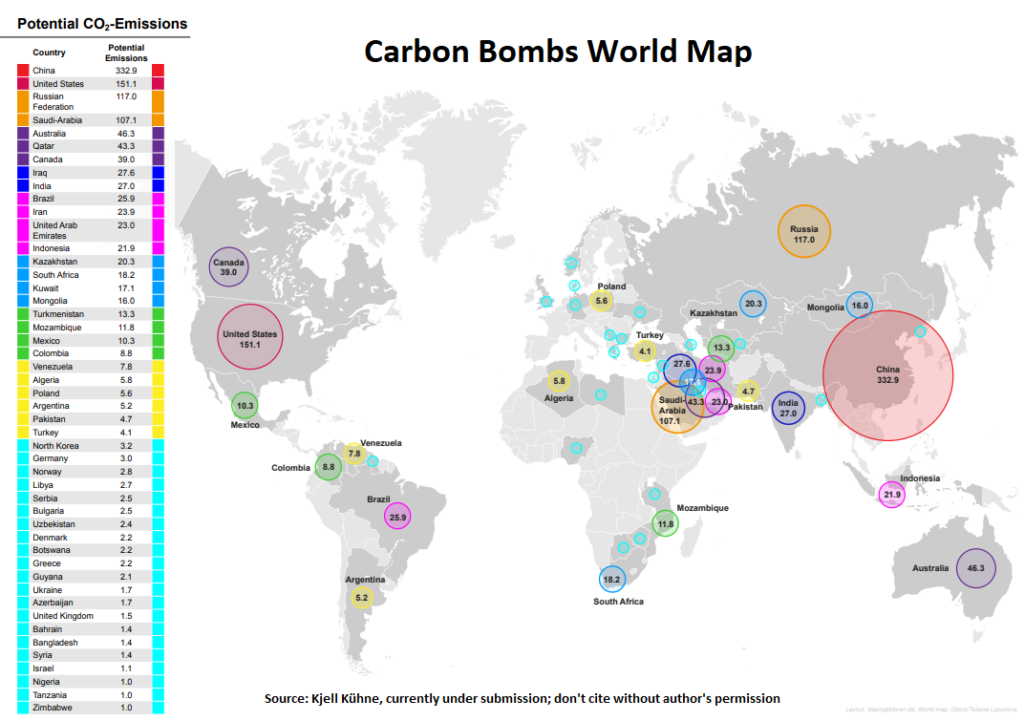
China alone accounts for 42.2% of the potential emissions in the dataset. Together with the next ten countries, it accounts for 84.5% of the global total.
Stopping new carbon bombs
Preventing new carbon bombs from starting is an urgent climate priority. According to the updated analysis, 21 projects are expected to begin extraction between 2026 and 2030, representing 28.8 Gt CO₂ in potential emissions.
Another 23 projects, previously expected to start between 2021 and 2025, remain classified as planned in the dataset, representing a further 52.9 Gt CO₂. Their current status requires further investigation.
Stopping these extraction projects before they begin, while phasing out existing fossil fuel extraction, is essential to meeting the Paris Agreement’s temperature targets.
Carbon Bombs Update 2025
Our latest factsheet, published in September 2026, presents the updated global inventory, country rankings, project status, and analysis of the largest and fastest-growing carbon bombs.
Research and further information
Our original peer-reviewed article in Energy Policy, Carbon Bombs – Mapping key fossil fuel projects (2022), explains how a “harvest mode” approach could help fit existing extraction projects within the Paris Agreement’s carbon budget.
In May 2022, The Guardian published an extensive investigation into carbon bombs, examining the global picture of major oil and gas extraction projects, excluding coal.
Explore the carbon bombs on the interactive map and identify their financial supporters at CarbonBombs.org.
For historical comparison, the original 2022 list of 425 carbon bombs remains available.
Help defuse a carbon bomb
Civil society organisations around the world are already working to stop these enormous fossil fuel extraction projects. Learn more about our Defusing Carbon Bombs initiative.
If you would like to help defuse a carbon bomb in your country or globally, we would love to hear from you. Please get in touch.